|
|

Golden Square, Hitchin, circa 1891
April, 2007
|
|
|
Golden Square, Hitchin, circa 1891 April, 2007 |
|
Tina Timlett (ttimlett @t hotmail.com) of Stevenage writes: Using census details I have located a gg grandfather, Fred Stevens, who lived at 20 Golden Square, Hitchin. I am trying to find out if this address changed name or just doesn't exist anymore.
|
|
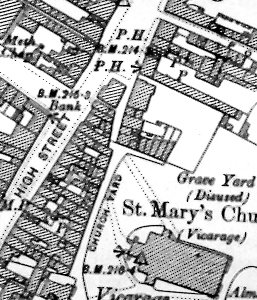
It is often possible to find out where a property mentioned in a census is by looking at the neighbouring properties - see Locating Census Addresses on Maps. If you look at the 1891 census again you will find that shortly before coming to Golden Square the census enumerator visited two public houses at the south end of Bancroft. These are The White Lion and The Crown - the two P.H. shown in the detail from the 1897 Ordnance Survey map. After Golden Square he visited Church Yard, and bizarrely the house numbers form a continuous series. This is confirmed by the route the enumerator took, described at the front of the enumerator's book. This defines his route as "... Wool Pack, Mr Fell's House, East side of Bancroft, Golden Square & Houses in East corner of Churchyard.
Looking up the Stevens family in the 1901 census it is clear that the census enumerator took a different route, which reads "Bancroft and Yards therein, east side of High Street, Golden Square, Church Yard and Almshouses, School Cottages ..."
|
|
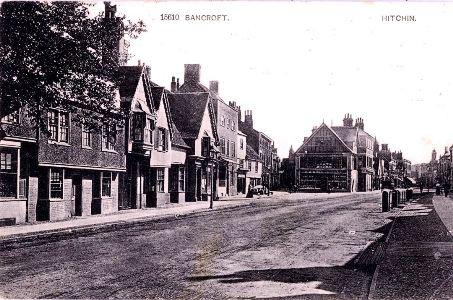
The Southern End of Bancroft, with the High Street to the right and the passage to the Church Yard on the left. Postcard by Blum & Degan Ltd with back suggesting a date for the photo of about 1904 or earlier. |
|
From the census evidence it would appear that relevant area is the south end of Bancroft and the passageway to the Churchyard. This is confirmed by the booklet The Street Names of Hitchin (Book 1) which says:
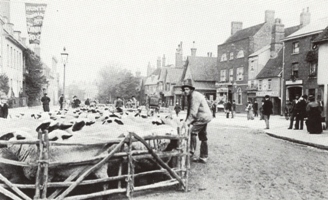
Earlier, though, this end [of Bancroft] and its link to the Churchyard had been called Golden Square, originally Gilden Square, after the Guildhouse of the Brotherhood of Our Lady, which existed from 1475 until its dissolution by King Henry VIII's commissioners in l548. The building still survives in an altered form adjacent to Lloyds Bank. There is evidence that at one time a market cross stood nearby and until the beginning of the twentieth century, the sheep and cattle market was held here.
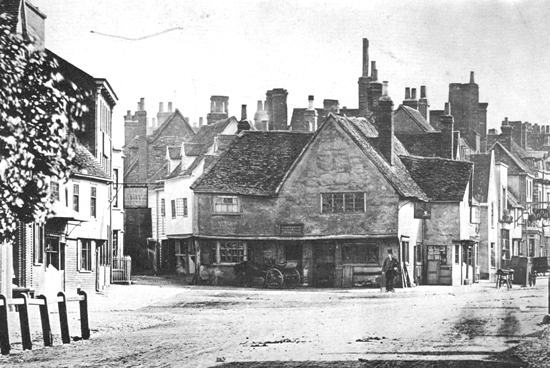
The Trooper at the southern end of Bancroft in 1860
Photograph by T.B. Latchmore reproduced in Old Hitchin
The building in the centre is The Trooper public house, which was demolished in 1899 to be replaced by Moss's cafe - which is why this location is sometimes referred to as Moss's Corner. (See also W. B. MOSS, Hitchin, from 1861) The White Lion is the public house whose inn sign hangs over the entrance to the alley to the churchyard.
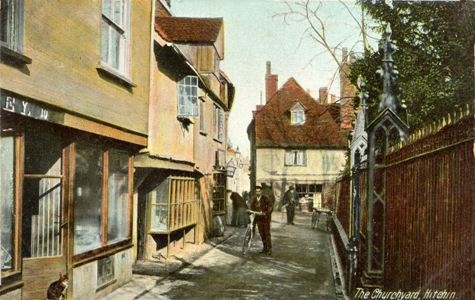 |
|
The Churchyard, Hitchin - B
& D card No 21216 - Posted 1906 |
There are many other views of the area in the many books on Hitchin - including a view of the N.W. corner of the Churchyard (the other end of the passage) by T B Latchmore in Hitchin Old and New.
I don't know modern Hitchin well, but there have been major developments in the area and Hitchin Inns and Incidents records that the White Lion and the Crown were demolished in 1966 to be replaced by the Crown and Lion and a Tesco Supermarket.
The White Lion
September 2008
Anthony Long (catherine.long4 @t ntlworld.com) of Tamworth, Staffordshire, writes: My great great great grandparents lived in Golden Square. His name was George Crawley and his occupation was a butcher. Her name Sarah Crawley, formerly Knight. My great great grandfather Daniel Crawley was born on 22 November 1854 at Golden Square, Hitchin, the birth was registered on 11 December 1854.
In the original query I looked at the 1891 and 1901 census to help work out where Golden Square was. On receiving your interesting message I decided to look at some earlier records as the Crawley family were landlords of the White Lion during most of the 19th century (Hertfordshire Inns) - and the White Lion was at the entrance to Golden Square.
The 1823 Pigots Directory lists Daniel Crawley, of the Hog Market, under "Butchers" and at the White Lion under "Taverns & Public Houses". Pigot's 1839 Directory shows Daniel Crawley to be a butcher in Bancroft Street and as landlord of the White Lion, in Bancroft Street. while Daniel Crawley junior was a butcher in Cock Street.The 1841 census list Dinah Crawley (Daniel's widow?) as the publican at the White Lion Inn, Sheep Market, with family Daniel (20, butcher), Mary, Emma and George.
The Post Office Directory for 1851 shows Daniel Crawley to be a butcher at the Sheep Market, while the landlord of the White Lion was Mrs Dinah Crawley. The 1851 census shows Daniel Crawley (a 31 year old butcher) and his 19 year old wife Martha as living in Golden Square, next door to Dinah Crawley (a 64 year old widow & publican), her son Emma (24) and son George (butcher).
The 1861 census lists Daniel (butcher) and family in the Sheep Market, next door to the unoccupied White Lion while George (a journeyman butcher - who probably worked for his brother) was in Golden Square with his family. The 1866, 1882 & 1886 Directories lists Daniel Crawley as the landlord of the White Lion and as a butcher in Bancroft Street. In 1871 Daniel was listed in Bancroft Street next door to an unnamed public house (presumably the White Lion, also in Bancroft Street) adjacent to Golden Square while George had moved to Mill Lane. The same applied in the 1881 census.
The above photograph of the Trooper suggests that the White Lion, and the adjoining butcher's shop were right at the entrance to the alleyway which was Golden Square. Between 1841 and 1886 they were variously described as in the Hog or Sheep Market, as being in Bancroft Street, or as being in Golden Square. It is important to realise that such variations in place names can often occur in towns at a time when most people could not read, and there were no formal post office addresses or street numbers.
If you can add to the information given above tell me.
| May 2010 | Link to Moss page | |