|
William KAY, of Tring Park, 1823-1838 and his son William Kay (1834-1865) |
|
||||||



September, 2010
Sandra Beaumont (sandra.beaumont @t virgin.net) of Shipston on Stour writes: I am trying to find out whether William Kay, who bought Tring Park in 1823 is related to our family. My mother had this information passed down to her and so have several other members of the family.
My great grandmother was called Rachel Kay and her father was Joseph Golding Kay who was born in Manchester. It is believed that Joseph's father owned a silk mill in Manchester but I have drawn a blank on obtaining further details.
Research has shown that William Kay of Tring Park was a textile magnate from Manchester and he had Tring silk mill built around 1823 although his brother from Macclesfield, Cheshire ran it for a while.
My great grandfather Joseph Golding Kay was, in his earlier years just a sizer but in later years he is shown on the censuses as a private gentleman and landowner which would indicate that he came into money later in life. Whilst I don't think he is a direct descendant of William Kay, his father could have been one of William's brothers or cousins. Whilst there is no money left now it is still intriguing.
I have discovered that William had at least two sons, Richard Smith Kay (the eldest son) who went to Oxford and died in 1857 and another William Kay (who inherited Tring Park for life) and who died in 1865.
If you could give me any further information on William Kay or his sons which would aid my research then I would be very grateful indeed.
 |
|
|
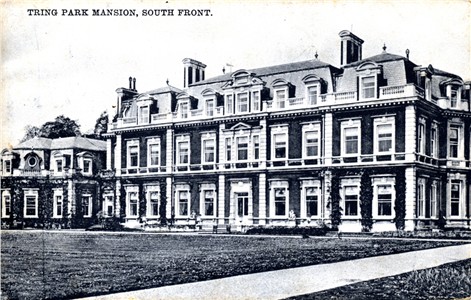
Tring Park Mansion (William Kay lived elsewahere and let the house) |
There is a short biography of William Kay in More Tring Personalities (unfortunately now out of print) and the following paragraph outlines his origins, which confirms what you have found.
William Kay was born at The Mains, Wigton, Cumberland, son of a yeoman farmer, and from whom he inherited £100, and property and land in Wigton. This small town was heavily engaged in the weaving trade, using workers recruited from within a ten-mile radius. The spinning factories here used imported cotton, locally-produced wool, and linen from flax grown on the Solway Plain. William and his brother, Joseph, obviously used the knowledge gained in their area to good effect, for it is recorded that they established themselves in the textile industry in Manchester. A trade directory of 1804 lists William Kay as a cotton manufacturer with a mill in Watling Street, Manchester. His elder son, Richard Smith Kay, was baptised in a city centre church. (It may have been that during this period he first met Nathan Rothschild, who lived in Manchester on his arrival in England, and whose immense middle-age he was sufficiently affluent to buy the Tring Park estate.
|
|
|
|
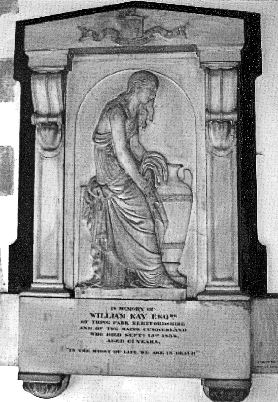
William Kay Memorial, Tring Church from Tring Silk Mill |
More relevant to your query could be what happened on his death.
After firmly making his mark in Tring, William Kay died in 1838. By then a man of considerable means, he resided in London at York Terrace, Regents Park. His end was sad, for the contemporary Carlisle Journal reported that William died of a head injury after being knocked down near his house by a horse and cart. He left a 26-page detailed and convoluted will, written by a lawyer's clerk in a looping copper-plate hand, and quite worthy of anything to be found in the legal novels of Dickens. He settled on his wife Helen a yearly sum of £1,600 for life - providing she did not re-marry. His older son, Richard, was left £500 a year for life, but the entire estate, including the mill, was bequeathed in Trust for his younger son, William. At the time of his father's death William junior was still a minor, and accordingly, for the purpose of the inheritance, was made a ward of the Court of Chancery. He died in 1865 as the result of a fall whilst hunting. He and his wife were childless, and the Court ordered the estate to be sold. After much legal wrangling, it was eventually offered for auction in 1872.
You mention that Joseph Golding Kay seemed to have come into money later in life so there may be clues in William Kay's will and records of the Court of Chancery, particularly if the money "appeared" after 1868. If the money came from William Kay's estate there should be a mention of Joseph somewhere in the paperwork. I am afraid I have no experience of Court of Chancery records.
While William Kay is mentioned in the book Tring Silk Mill, which includes a picture of his memorial, there is no additional information relevant to your enquiry.
July 2012
Sandra writes again: Just a follow up on the information on William Kay of Tring Park and my search to find out whether my great, great grandfather Joseph Golding Kay was connected to him. I've just located Joseph Golding Kay in the UK poll book of Wigton in Cumbria in 1868. As this is the place where William Kay was born I am now even more convinced of a link between them. It is definitely my great grandfather named in the poll book as it also gives his address in Yorkshire. Why he was in Wigton at the time (or had a connection to the place) I do not know and further research is needed but I would like to thank you for the excellent info that you gave me as without it I would never have considered looking at the Wigton area for information.
The Standard of September 17, 1838 [British Newspaper Archive] reported the death of William Kay as follows
Sept. 15, at his home in York-terrace, Regent's Park [London], William Kay, Esq., of the Mains, Cumberland, and Tring-park, Hertfordshire, in his 62nd year.
The London Gazette and People's Political and Social Reformer published an identical report on September 23, 1838, while the Bury & Norwich Post also mentioned the news on October 3rd
Sandra immediately responded with an advert from the Carlisle Patriot of September 20, 1844, which gives more information about the Cumberland property
To be sold by public biddings
To be peremptorily sold by public biddings, pursuant to an order of the high court of Chancery, made in a cause of HOWARD v. KAY, with the approbation of SIR WILLIAM HORNE, one of the masters of the said court, at the Bush Inn, Carlisle, on Thursday the 3rd day of October, 1844, at one o'clock in the afternoon, by Mr. JOHN ALLEN STOKES, the person appointed by the said master.
A valuable freehold and tithe free estate with the land tax redeemed, called "MAINS", "COLBERT HILL" and "CROOKS", situate close to the market town of Wigton, in the County of Cumberland, containing 145A OR 17P. meadow and arable land in two lots.
January 2014
Mikki French (Micknmikki @t talktalk.net) of Ripon Yorkshire writes: This isn't a question, it's just a big thank you for the info you have on the web site with the above named person. I am looking into the history of William Junior's wife, Rose Louise? ,who had an "adopted son" who was a lunatic, and when she died in 1894, and left over £102,000, this child became my great grandfather's ward. Gossip has it that he may have been the father. I can't find the child before 1894,on any of the censuses, so I'm afraid curiosity got the better of me and I started to research the family. Mikki later provided additional information and the following has been updated by recording the extra references in brown.- with further updates in February.
|
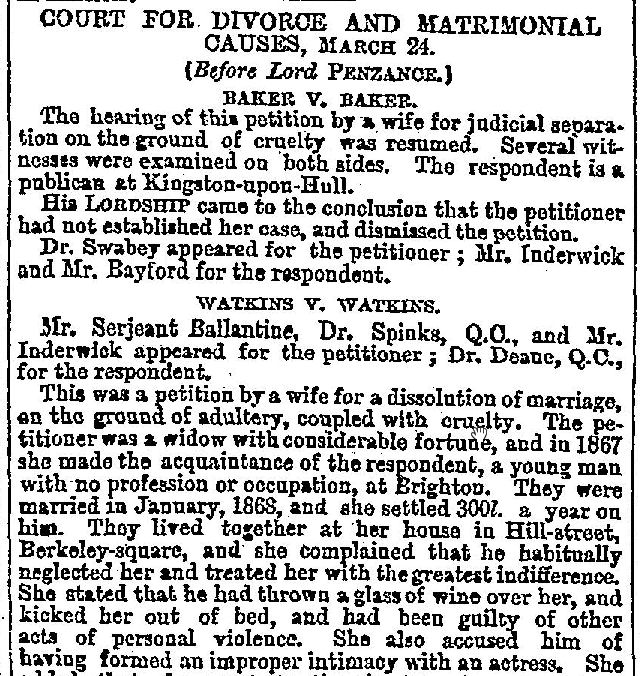
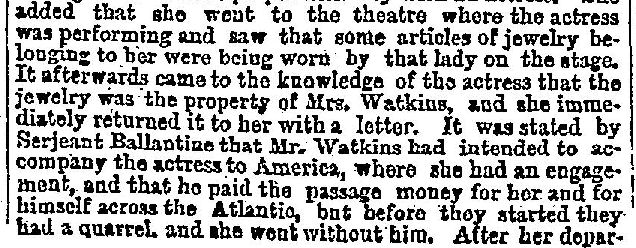
While no question was asked I thought it would be useful to say something about William Kay and his wife, because of the connection with Tring Park. I did a quick check of the British Newspaper Archive for relevant family announcements, and found an interesting story involving a divorce - which I filled in with some marriage certificates and selected census returns. I also found an earlier reference to the adopted child, George Louis Howard Kay, and appear to have discovered the link between him, William Kay junior's wife, and the Reed family. 1851 Census 30 Princes Street, St Dunstans, Stepney, Tower Hamlets
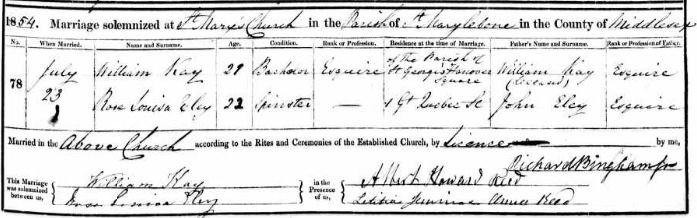
It would seem that William Kay and Rose Louisa Eley married at Marylebone soon after he was 21, and no longer a ward of court - and as far as I can see there was no announcement in the press, which one might have expected at this level of society. Interestingly the witnesses were Albert Howard Reed and Letitia J C Reed. Mikki reports: Aunt Mary said that she thought Rose was a Polish refugee! My other Aunt, Trishie, said that Rose was a prostitute. She saved William's life by warning him in Paris that he was about to be murdered ! (In light of what I've been reading in the newspapers, she may not have been far off the mark! )
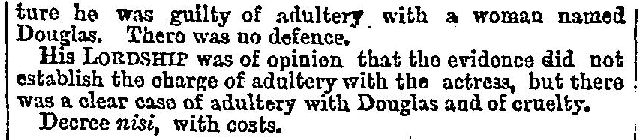
In 1854 and 1855 there were some court cases, eventually involving a false imprisonment of Mr Kay, which I have not investigated, but relate to the following short extract from a report in the London Standard of 17th November, 1854:
DEATHS: KAY: On the 21st ult. [February 1857], at Naples, of pleurisy, Richard Smith Kay, Esq., eldest son of the late William Kay, Esq., of Tring-park, Herts DEATHS: KAY: On the 29th ult [March 1860], at her residence, 15, York-terrace, Regents-park, Helen, relict of William Kay, Esq., formerly of Tring-park, Herts. DEATHS: ISMAY: On the 28th ult [October 1863], at Bunker's Hill, near Carlisle, Mary, widow of the late John Ismay, Esq., of Brackenlands, and last surviving sister of the late William Kay, Esq., of Tring Park, in the 84th year of her age. BIRTHS: KAY: On the 25th ult [March 1864], in Hill Street, Berkley-square, the wife of William Kay, Esq., Lord of the Manor of Tring, of a son, stillborn. DEATHS: KAY: On the 15th inst [February 1865] at the Grand Hotel, Paris, after a few day's illness, William Kay, Esq, of Tring Park and 36, Hill-street, Berkley-square, aged 31. At the end of April notices appeared relating to the creditors. Mikki reports: My Aunt Mary said that William was a close friend of Albert Reed. William died at the Hotel Belleville in Paris. His London address at that time was 36 Hill St. Berkeley Square. There are 2 telegrams that my cousin has, sent from the Hotel on 15th February 1865. The first timed at 10.10 states : Monsieur est malade venez tout de suite response attend. The second timed at 11.30 states: Monsieur est tres mal venez au plus vite. According to Andrew Kay ( I don't know who he is ) the cause of death was a hunting accident.
Christening; George Louis Howard Kay 8th May 1866 mother Rose Kay St Peter & St Paul, Cudham Kent. Mikki says grandmother had said Albert Reed was the father. Aunt Trishie said that Rose had a child called George who became insane through vd. There was a male nurse to look after him, and ultimately he became violent went into an institution. Birth Registration - George Louis Howard at Marylebone, July-September, 1866
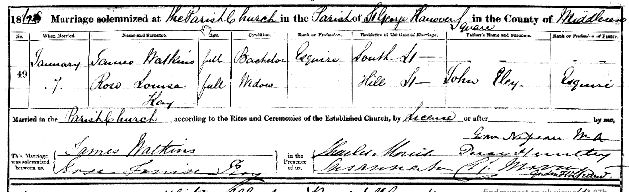
MARRIAGE: On the 7th inst [January 1868], at St George's, Hanover Square, by the Rev. Evan Nepeon, Chaplain-in-ordinary to the Queen, James Watkins, Esq., late of the 18th Hussars, to Mrs William Kay, Esq, relict of the late Wm. Kay, Esq, of Hill-Street, Berkley-square, and Tring Park.
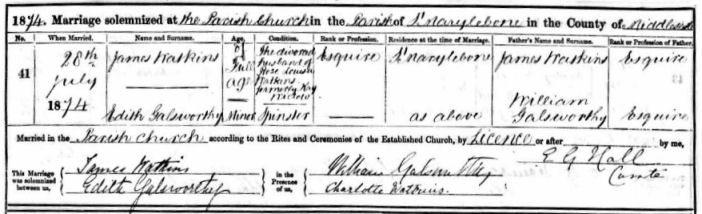
MARRIAGE: WATKINS - GALSWORTHY: on the 28th ult. [August 1874], at the parish church of St Marylebone, James Watkins, Esq., late 18th Hussars, to Edith, only child of William Galsworthy, Esq, of No.2, Harley Street, Cavendish Square.
1871 Census: Baker Street, Marylebone, London
1881 Census: Park House, Earls Court Road, Kensington
1887 Death: Eleanor Sarah G Keely, aged 53 - registered Kensington March 1887
1881 Newlands, Lower Tooting, Surrey - George L H Kay (15) was a pupil at School 1891 Census: Park House, Earls Court Road, Kensington
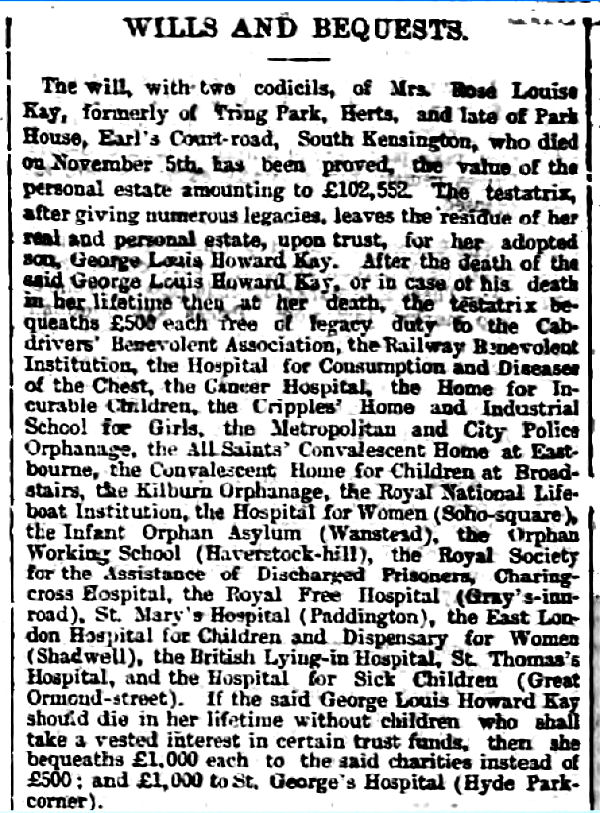
Death 1894: Rose Louise Kay, 60, Register Kensington December
Various papers including the Whitstable & Herne Bay Herald, 23rd March, 1895
The Will of Rose shows that Henry Howard Reed and his wife Eliza were appointed as his guardians and took possession of Park House, or an alternative residence, during George's life.
1901 Census, 1 Victoria Gardens, Broadstairs, Kent
1911 Census, 1 Victoria Gardens, Broadstairs, Kent
|
|||||||||||||||||||||||||||||||||||||||||||||||||||||||||||||||||||||||||||||||||||||||||||||||||||||||||||||||||||||||||||||||||||||||||||||||||||||||||||||||||||||||||||||||||||||||||||||||||||||||||||||||||||||||||||||||||||||||||||||||||||||||||||||||||||||||||||||||||||||||||||||||||||||||||||||||||||||||||||||||||||||||||||||||||||||||||||||||||||||||||||||||||||||||||||||||||||||||||||||||||||||||||||||||||||||
The following notes were made to try
and track down the origins of Rose Louise Elly
The best fit (poor fit on year, place, father's forename name) on familysearch is a Rosina Sarah Lewis Ely who was baptised on 23 November 1828 at St Saviour, Southwark, Surrey with parents James and Sarah Ely - and I could not find any census data to back this up. Can't totally rule it out as Rose and Rosina could be one and the same an so phonetically are Louise and Lewis. If, as suggested, she was a prostitute, she might have deliberately misrepresented her father's name. The 1851 census suggested that Rose might have a sister Eliza, both being born in St Lukes (part of Holborn including City Road, Finsbury, Old Street and Whitecross Street) but this provided no definite clues. Another possibility explored was the Eley and Keely were just different spellings of the same name and Rose was related to Eleanor Keely. Eleanor Sarah Grace Keeley was christened on 22 February 1832 at St James, Paddington, the daughter of Robert and Sarah Keeley, and she can be followed through to her death with no obvious evidence of any relationship. So the real identity of Rose remains something of a mystery. If anyone has any ideas .... |
|||||||||||||||||||||||||||||||||||||||||||||||||||||||||||||||||||||||||||||||||||||||||||||||||||||||||||||||||||||||||||||||||||||||||||||||||||||||||||||||||||||||||||||||||||||||||||||||||||||||||||||||||||||||||||||||||||||||||||||||||||||||||||||||||||||||||||||||||||||||||||||||||||||||||||||||||||||||||||||||||||||||||||||||||||||||||||||||||||||||||||||||||||||||||||||||||||||||||||||||||||||||||||||||||||||