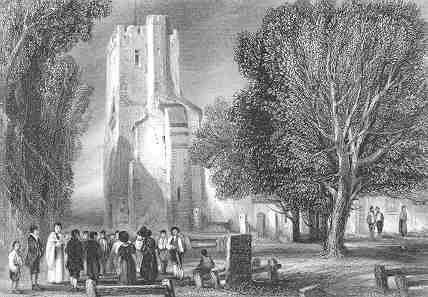
A funeral at St Michael's Church, from Henshall, 1840
An interesting feature are the grave boards which were commonly used to mark graves at this period, and earlier. These consisted of an oak board carrying an inscription and supported by oak posts at the head and foot ends of the grave. The widespread use of these grave markers, which were cheaper than stone, stopped in Victorian times and it is extremely rare for any to have survived. The page on Little Gaddesden's church includes a further picture of grave boards, and there is one still standing among more recent gravestones. There are some comparatively recent ones, in Tewin churchyard. The "well preserved" board at Lilley is undoubtedly a replacement of the original grave marker.
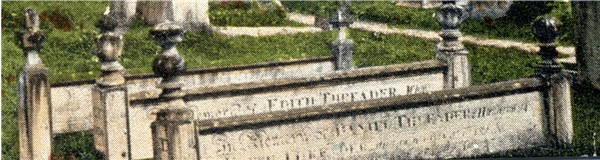
Details of grave boards at
Ayot
St Lawrence from a postcard published circa 1905.
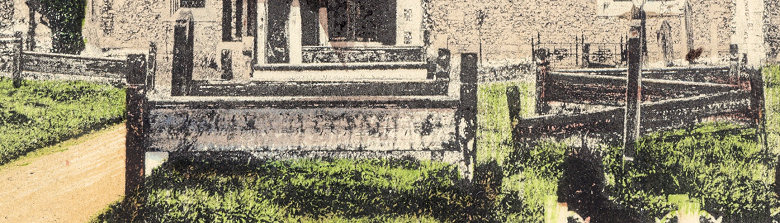
Grave Boards at Ridge Church circa 1910
During 2012 FindMyPast are to digitise the Hertfordshire Parish Registers and Bishops Transcripts held at HALS up to 1910 for baptisms, 1928 for marriages and 1990 for burials.
See also:
The Condition of Hertfordshire Graveyards
Looking for 20th Century Burials
Burials in Stevenage, Early 20th century looks at the fate of the older parish graveyards
Hertfordshire Churches - for an illustration of a preserved graveboard
HORN, Undertaker, Hemel Hempstead, early 20th century
Just because your ancestor was buried does not mean they are still in the grave, as the news item "Was your Ancestor resurrected?" shows.
Updated July 2016