|
The Brickmakers of St Albans William Alexander Dixon 1860-1934 |
|
||||
|
The Brickmakers of St Albans William Alexander Dixon 1860-1934 |
|
||||
William Alexander DIXON was the son of a corn dealer who was based in Alma Road and was agent for a brick yard in Sandpit Lane for no more than about a dozen years from about 1891.
[Unless otherwise stated family information comes from the IGI, VRI, and census data.]
The first reference I have linking William A. DIXON to brickmaking is the 1891 census when he was living at Alma Road. He was described as a 31 year old brick merchant born in St Albans. In July 1893 the following advert was appearing in the Herts Advertiser.
|
W A DIXON |
The St Albans Almanack lists few or no names in Alma Road before 1888 when W A Dixon is listed as living there. He is also listed in 1889, (not 1890), 1891, 1892, 1893, (not 1894 through 1900) and 1901 (at No 39,). He is listed as living at 122 Fishpool Street between 1897 and 1900. The 1898 Kelly's Directory lists William Alexander Dixon as a brick maker of 122 Fishpool Street, which was also listed as his private address. However he was still trading from Alma Road in 1902 when the following advert appeared in The City of St Albans.
|
W. A. DIXON 39, ALMA ROAD, ST. ALBANS. —————— BEST COALS Supplied at Lowest Possible Prices. Order by Post receive prompt attention. |
The latest reference comes from the 1904 Directory of Clayworkers which records that Mr W A Dixon, Alma Road, St Albans, was agent for the Sandpit Lane Brick Fields. The 1898 large scale OS map shows a brickworks about a mile east of Bernards Heath, near Marshalswick, and just north of Sandpit Lane. A 1906 reference suggests that the disused brick pits at Marshalswick were being used by John Cable, a local jobmaster, as a tip for the city rubbish. However they may have been taken over by W. G. Bennett.
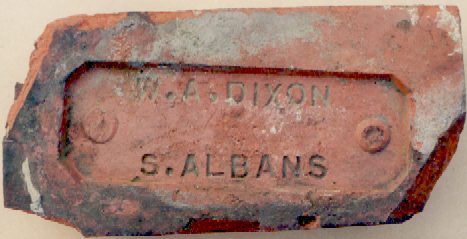
When houses 29-37 were demolished in Verulam Road, brick marked W. A. Dixon were found at No. 35. The picture shows a brick recovered in Culver Road in 2001 [Thank you Roger Miles].
|
William DIXON |
59 |
Head |
Retired Corn Dealer |
St Albans |
|
Sophia DIXON |
46 |
Wife |
Retired Corn Dealer Wife |
Baldock |
|
William A. DIXON |
21 |
Son |
Drapers Assistant |
St Albans |
|
Ernest DIXON |
13 |
Son |
Scholar |
St Albans |
|
Albert DIXON |
11 |
Son |
Scholar |
St Albans |
|
Ann G. DIXON |
9 |
Daur |
Scholar |
St Albans |
William Dixon senior was not in the area at the time of the 1851 census - but the evidence from the 1851 census combined with the following trade directory entries suggests that he was in business with an Ernest Dixon (his father or brother?) and had links with Redbourn. The entries suggest that he may have retired from the business in the 1870s (through ill health) and probably died in 1881/2.
January 2004
Wilma Wright (wilroy @t shaw.ca) of Edmonton writes My husband's great grandfather was William Alexander Charles Dixon, born Dec 26, 1859 in St. Albans, son of William & Sophie Dixon. He died Feb 1, 1934 in Edmonton, Alberta, Canada.
He married married Margaret Elizabeth Booth, Sept 11, 1882 in Emmananuel Church, Camberwell Rd., London. Margaret was born May 4, 1859 in Carey Place, Watford, daughter of John Stocks Booth (first organist at St. Albans Cathedral) and Esther Anne Blackwell. William and Margaret had 12 children. About 1906, he and his brother, probably Ernest, immigrated to Edmonton, Alberta. Their plans were to start a brickyard. However, for some reason, plans changed and William opened a general store. Margaret and all the surviving children immigrated the following year. We have speculated on the reason for immigration. Alberta had just become a province of Canada as opposed to being a part of the North West Territories and Edmonton was the capital city of the new province. It was a boom time for the prairie city.
Thank you for this very helpful information - which explains why William vanished from St Albans. A lot of people went from England to the Alberta early in the 20th century - which is why my wife and I were briefly in Edmonton in 2003, on our way to the centenary celebrations in Lloydminster and one of Helen's relative built the first wooden house there. At the time William left England most small brick makers in Hertfordshire were going out of business because of the competition from the far cheaper mass produced bricks from more suitable geological deposits in Bedfordshire. William may well have left England for this reason - and perhaps hoped that there would be a demand for bricks in the new state of Alberta. I wonder if William found that most of the buildings being put up in Alberta in the early days were of wood - and it could be that the local geology lacked the kind of brick earth he would have needed for making bricks.
April 2007
Nigel Gale (nigelgale @t tiscali.co.uk) writes: I happened across your interesting articles on bricks and wanted to share with you that much of my house, 2 Worley Road, St Albans, is made of red bricks stamped "WA DIXON ST ALBANS" in the frog of the brick, like the one shown in the article. We understand that the house was built about 1905, so that fits in with your chronology.
August 2013
Roger Miles (rogmiles @t compuserve.com) of St Albans writes: In the section on William Dixon it is speculated that claypits in Marshalswick, north of Sandpit Lane may have been subsequently used for City refuse. There is evidence for this. Brian Moodey, a past secretary of the St Albans Archtectural and Archaeological Society, lives in Rose Walk, a turning off Sandpit Lane. His back garden abuts the site of the old pits. He has a fine collection of old glass bottles which he dug up!
February 2016
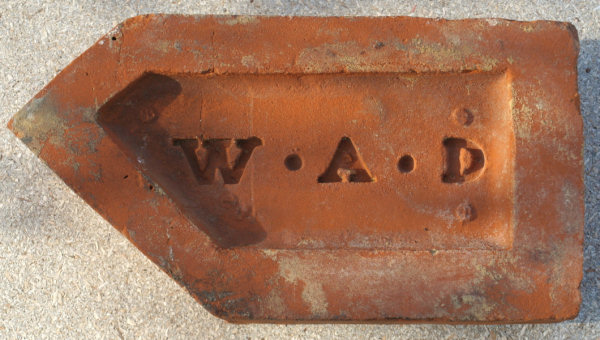
Roger Miles (rogmiles @t compuserve.com) of St Albans writes to say he had acquired two good examples of Heath bricks today - made by William Dixon. They are from a house in Culver Road, No 47, that is being modernised, close to where I got the one which is pictured above.
The above is a squint. The builders were removing a chimney breast and I think the squints were used
around the fireplace opening to form a chamfered reveal. A better quality brick would be required in that location.
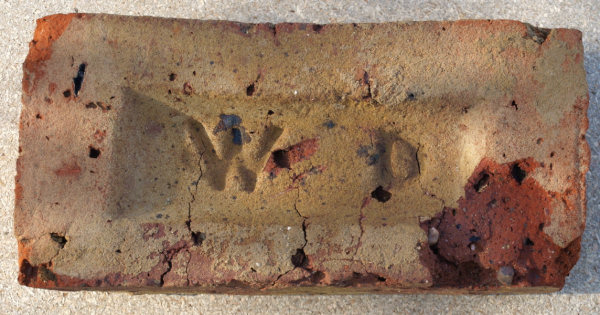
This brick is what I refer to as a BH Grotty. It has just W D marked, in poorer lettering, matching the quality of the brick. The contrast in the two bricks demonstrates the variability of the clays in the locality - I am assuming they would have been made in the same place. All the other bricks I saw were Grotties and most were unmarked.
There is clearly a marked difference in the quality of the clay used - and I understand that the local brick earth had quite a few small stones in it - and these can be seen in the "grotty" example which may be a hand made brick made of raw clay, for use in situations where the blemishes and imperfections would not be obvious.
For better quality bricks the clay would be prepared in a pug mill, which involved adding water to make a slurry and stirring it so that the stones sunk to the bottom. I don't know much about the process but wells about 200 feet deep had to be dug to get water to the Bernards Heath level - and one of the "byproducts" was that in 1833 the brickmaker Joseph Fowler established a waterworks to provide piped water to the borough. (The recent "hole in the road" could involve a 200 foot deep well used to bring water to the surface to help prepare the brick earth. After all the well would have had to be dug by hand so would have to be a reasonable diameter.)
The other factor to be considered is whether the squint brick is machine made - as we know that there was a brick-making machine installed on the Heath in 1894, and this may well have required stone-free clay. I have done more research on this (not yet online) and while I don't know what happened to it I do know that shortly after the machine was installed the company that made it in Sydney, Australia, went bankrupt.
If you can add to the information given above tell me.