Cassio Hamlet, Watford
September, 2006
|
|
||
|
|
|
|
|
Cassio Hamlet, Watford September, 2006 |
|
||||||
Joy Taylor, nee Copley (joy @t joytaylor.wanadoo.co.uk) asks Would you have known or do you have any photos of Cassio Hamlet? It no longer exist. My Granddad, George Charles Copley, he was born at No.12 Cassio Hamlet, Watford. in 1893. He was only a child of 8 years old, but must have qualified to be an Art Printer, at some stage, his father, my G Grandfather Joseph Copley, was a Masons Labourer, at the time of the 1901 census, but as I have gone back in to the census of my family history, I can see that they were well in to the printing business, as there are many Print Compositors, I have learnt with enthusiasm that, Watford was the printing Town of the country.
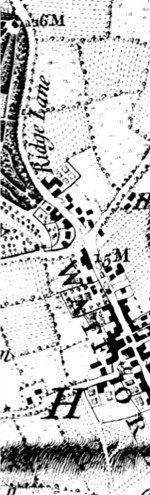
Watford High Street is in fact part of the old Roman road and in the 18th and 19th century it was part of the Sparrows Herne Turnpike, which ran from Bushey to Aylesbury, Bucks. Because it was a busy route from the Midlands into London it was not only a market town but provided services to a considerable volume of passing traffic. At the north end of the High Street there was a crossroads, and the the Roman road/turnpike continued as Hempstead Road, with the large house Cassiobury, with its park, on the west side. Cassio Hamlet was a small group of houses just north of the crossroads. It is shown on the Dury and Andrews map of 1766 (right), and Nunn (The Book of Watford 2nd ed) has a small picture of the interior of one of the 16th century cottages.
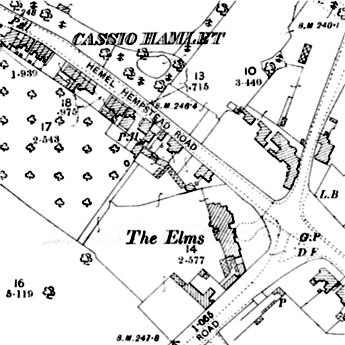
By the time of the 1901 census (see 1896 OS map above) a big house called The Elms had been built on the corner nearest the crossroads and the cottages started at number 3, with number 8 being the Horns public house, and your ancestors living in number 12.
I have located 2 published photos of the hamlet, (reproduced here reduced size) but neither show your ancestor's home.
 This
is a view from the crossroads looking north along Hempstead
Road. The gate leads into the garden of "The
Elms" and the first building is numbers 3 and 4 - occupied by Charles
Wilson (gardener) and Henry Wentworth (coachman). The sign for the Horns
Public House (number 8) can just be seen in the distance. The street
lighting would have been gas.
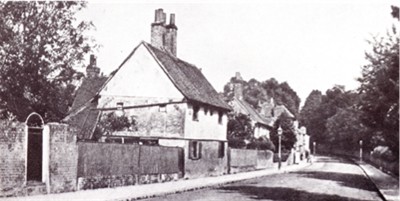
This
is a view from the crossroads looking north along Hempstead
Road. The gate leads into the garden of "The
Elms" and the first building is numbers 3 and 4 - occupied by Charles
Wilson (gardener) and Henry Wentworth (coachman). The sign for the Horns
Public House (number 8) can just be seen in the distance. The street
lighting would have been gas.
A version of this picture is in Watford, A Pictorial History (1951, reprinted 1973) - which also contains pictures of The Elms (built 1717), the crossroads and the new Town Hall which was built here and opened in 1940. A much larger version is in The Book of Watford 1st edition.
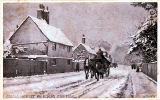
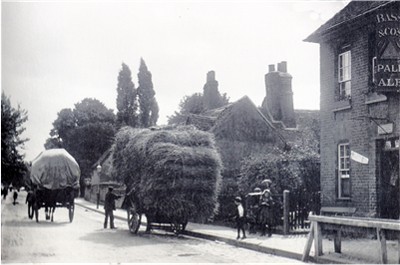 This
is a view looking south from outside the Horns Public
House. Haycarts would have been a common feature along the road until
the coming of the motor car led to a considerable reduction in the number of
horses to be fed. A larger digitally coloured version of this picture is
available in The Book of
Watford 2nd edition and also in Watford
Past (still available new).
This
is a view looking south from outside the Horns Public
House. Haycarts would have been a common feature along the road until
the coming of the motor car led to a considerable reduction in the number of
horses to be fed. A larger digitally coloured version of this picture is
available in The Book of
Watford 2nd edition and also in Watford
Past (still available new).
According to Hertfordshire Inns & Public Houses there is a reference to "Le Horns" in 1732 and in 1756 it was kept by Hannah Lea and had accommodation for three men and stabling for 2 horses. It is still there, although it has been rebuilt and is now numbered 1 Hempstead Road. An 1880s map and a modern aerial view of the much redeveloped area is available on Old Maps.
It could be worth contacting Watford public library (contact details Herts County Council web site) which has an excellent local studies section, to see if they have any old photographs showing number 12.
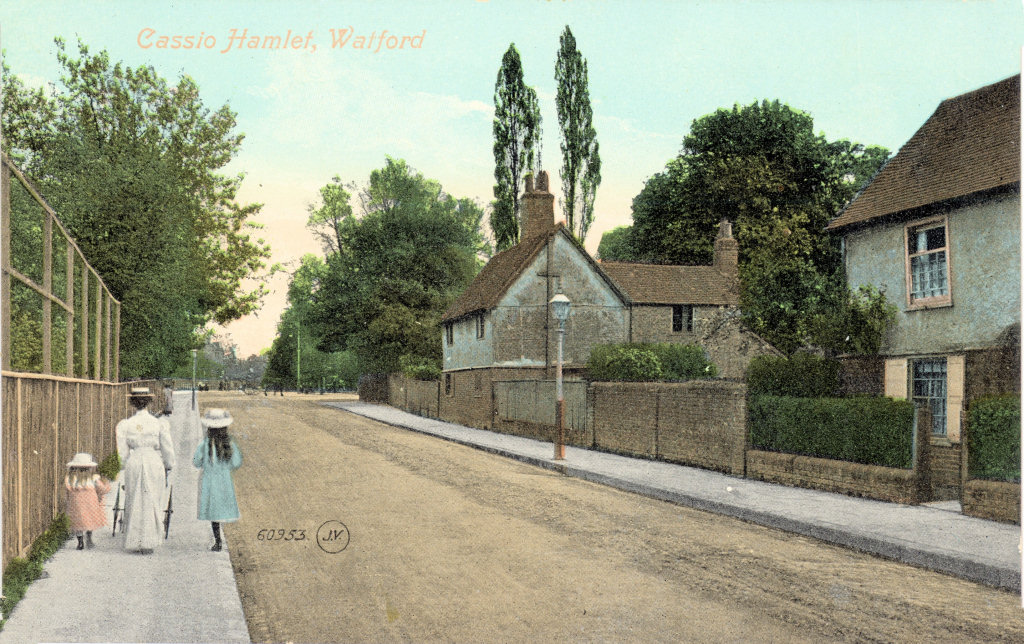 |
Cassio Hamlet Valentine's Series 60953 JV A view of Cassio Hamlet looking south along Hempstead Road, towards the Cross Roads, photographed by Valentine in 1908 Other cards probably photographed on the same day show the Lower High Street, Watford, and Leavesden Woods Avenue. |
December, 2009
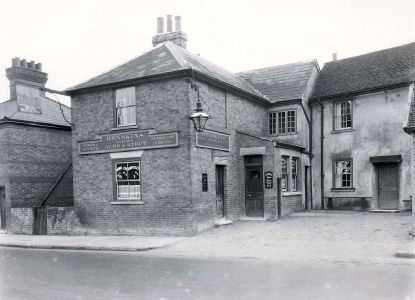 |
The Dog, Cassio Hamlet Geoff Dodd kindly provided this picture of "The Dog" public house, Cassio Hamlet, which he says was 28 Cassio Hamlet until 1933, and then became 29 Hempstead Road. It was demolished in the 1960s. The Dog was formerly the
Holly
Bush, probably kept in 1756 by John Bowden and with stabling for two
horses, though the was (later at any rate) another
Holly Bush in
Watford. Brought, still as the
Holly Bush, by
William Smith, of
Watford, Brewer, in 1773.
The Dog by 1823 when a friendly society
was established here. In the middle of the [19th century] a
favourite pull-up for carriers on their way to
London.
|
|
If you can add to the information given above tell me.
| September 2006 | Page created | |
| December 2009 | picture and information on "The Dog" | |
| September 2010 | PC by Valentine | |
| December 2013 | Cassio snow link |